
A plate heat exchanger plays a key role in the on-board cooling system. Contamination between the plates and wear on the gaskets can affect the operation of the PHE and make regular maintenance necessary.
In February 2026, we received a Hisaka plate heat exchanger from the MV Challenge Prime on behalf of EDR for a complete overhaul. We dismantled the PHE, cleaned the plate pack, fitted new NBR gaskets and reassembled the heat exchanger. Following reassembly, we tested both circuits separately for leaks.
Condition on arrival
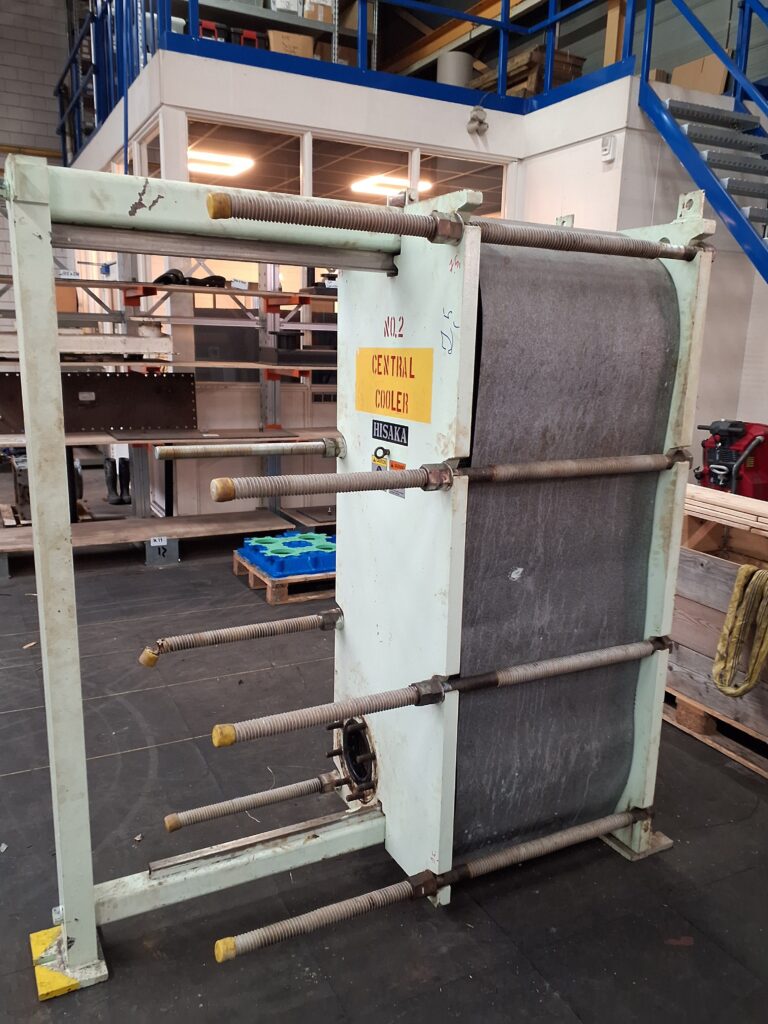
The Hisaka plate heat exchanger was delivered to our workshop complete with its frame. The PHE was constructed from titanium plates 0.4 mm thick and measuring 1505 x 510 mm.
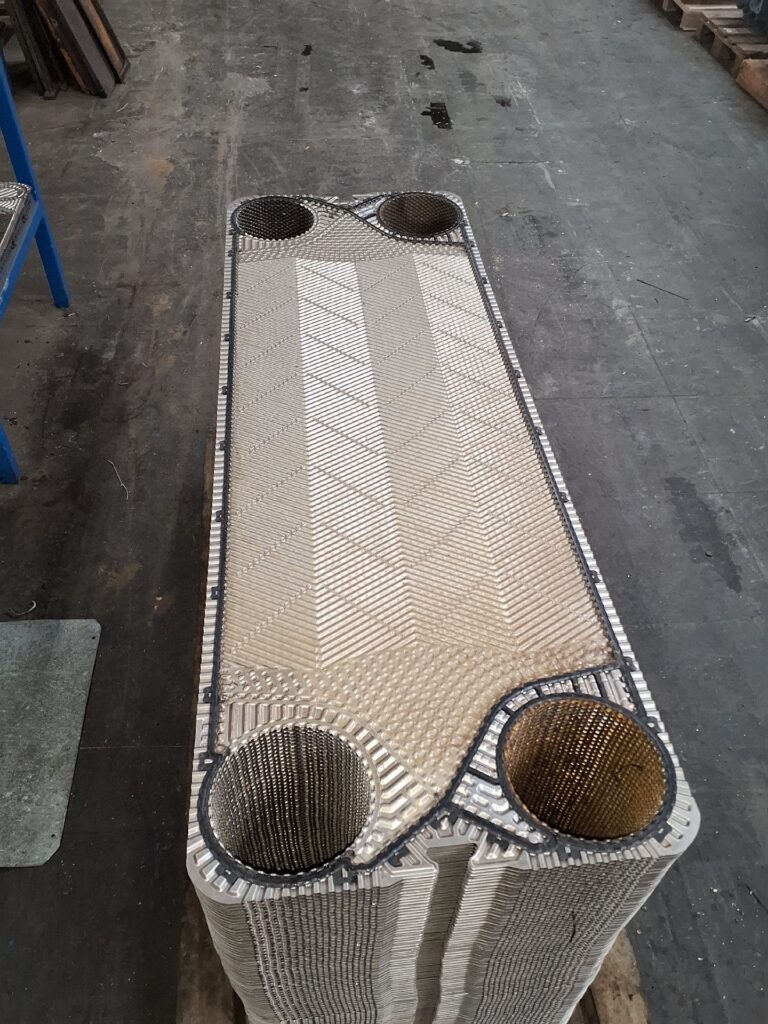
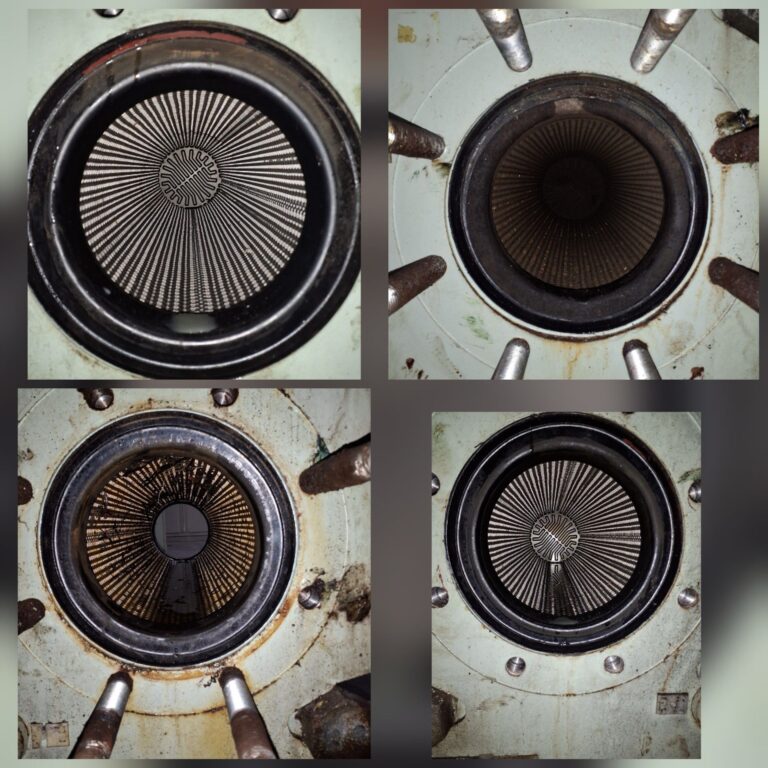
During the initial inspection, we found no leaks and the gasket grooves were in good condition. However, visible contamination was evident on both sides of the plate pack.
Prior to dismantling, we measured a distance of 670 mm between the main plates. The scope of the work therefore involved not only cleaning the plates, but a complete overhaul of the heat exchanger: dismantling, cleaning, resealing, reassembly and testing.
The challenge
A full PHE overhaul involves more than just removing contamination. In order to clean the individual plates properly, the entire plate pack must be opened. This also involves removing the existing gaskets and any residual gasket material.
The heat exchanger must then be reassembled in the correct configuration. The plate sequence, the fitting of the new gaskets and the compression gauge of the plate pack all play a key role in this.
In the case of this Hisaka PHE, this meant that we treated the entire plate pack step by step before the heat exchanger could be reassembled and tested.
Operations
Following the initial inspection, we completely dismantled the Hisaka PHE. By opening up the plate pack, we were able to gain easy access to the individual plates, gaskets and sealing surfaces, and carry out each stage of the overhaul in a controlled manner.
We began by removing the existing gaskets and any remaining gasket residue. The titanium plates could then be cleaned individually. To do this, we used a combination of high-pressure cleaning and chemical cleaning to remove any contamination from the plate surfaces.
In total, we cleaned 179 titanium plates. After cleaning, the plates were prepared for the reassembly of the heat exchanger. We fitted new NBR clip-on gaskets supplied by the owner and also installed five new liners.
We then reassembled the plate stack according to the drawing. In doing so, we checked the plate sequence and assembly before the plate pack was placed back into the frame. The plate stack was subsequently compressed under controlled conditions to a final dimension of 637 mm between the main plates.
Following the complete rebuild, a quality control check was carried out. We tested the fresh-water circuit and the seawater circuit separately for leaks. The fresh-water circuit was tested at 5.3 bar and the seawater circuit at 4.5 bar. Both circuits passed the pressure test without any leaks being detected.
The full scope of the project therefore comprised:
- Dismantling the plate heat exchanger
- Removing existing gaskets and gasket residue
- High-pressure cleaning of the PHE
- Chemical cleaning of the plate stack
- Cleaning of 179 titanium plates
- Fitting of new NBR clip-on gaskets
- Fitting of five new liners
- Re-assembly of the plate stack in accordance with the drawing
- Re-installation of the plate stack into the frame
- Compression of the plate stack to 637 mm
- Pressure testing of both circuits
- Preparation of the PHE for transport
Cleaning the plate pack
During dismantling, we first removed the existing gaskets and any remaining gasket residue from the grooves. This fully exposed the individual plates for cleaning.
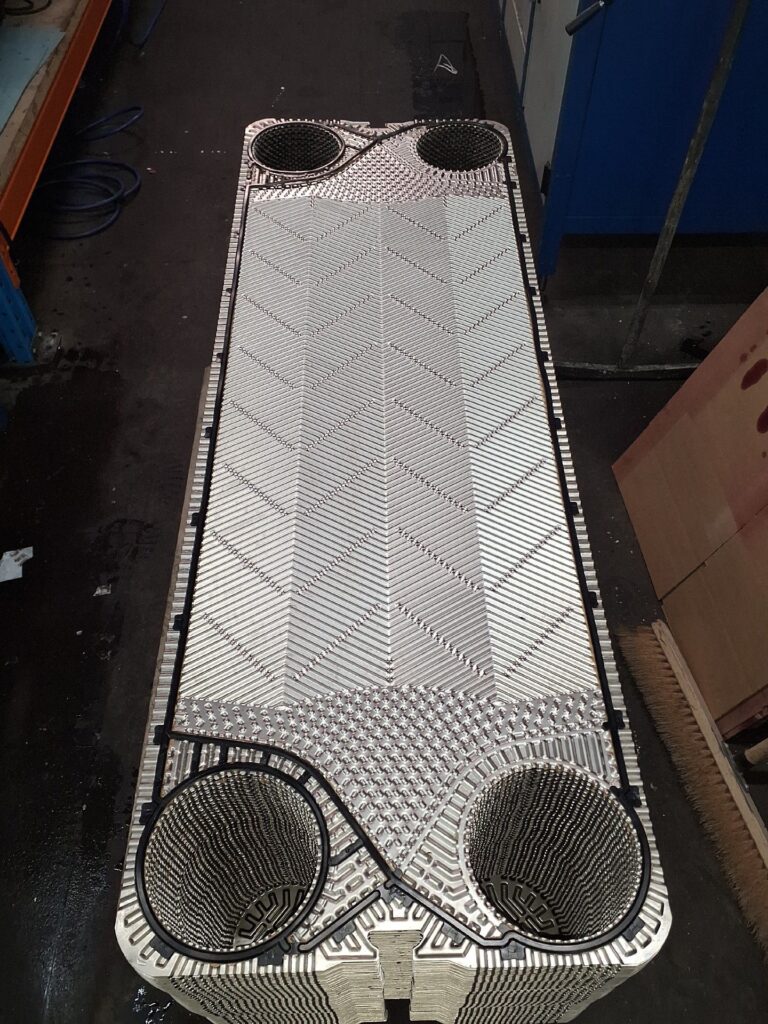
We then treated the plate pack using a combination of high-pressure cleaning and chemical cleaning. The difference is clearly visible in the project photographs: prior to the work, there was contamination on the plate surface, whilst after cleaning, the profile of the titanium plates was once again clearly visible.
The profiled plates of a PHE together form narrow flow channels through which the various media flow. Contamination on the plate surface can affect this flow and the heat transfer. By fully opening the heat exchanger, we were able to clean each plate individually and thoroughly.
The focus of this overhaul was on cleaning, resealing, reassembling and testing the PHE. No pre- and post-measurements of cooling capacity were carried out for this project. We therefore do not attribute any measured improvement in heat transfer to this work.
A crack test was also not part of the agreed scope. The work centred on dismantling and cleaning the plate pack, replacing the gaskets, reassembling the PHE and carrying out the subsequent pressure tests.
New gaskets and liners
Once the plates had been cleaned, we were able to begin reassembling the PHE.
During dismantling, we had completely removed the existing gaskets and any remaining gasket material. We then fitted new NBR clip-on gaskets supplied by the owner. We also installed five new liners.
The gaskets provide the seal between the individual plates and help to keep the various flow channels separate from one another. Correct fitting of the new gaskets is therefore a crucial part of reassembling the plate stack.
Only after the plates had been cleaned and the new gaskets fitted could the entire plate stack be reassembled in the correct configuration.
Reassembling the plate stack
After fitting the new gaskets, we reassembled the plate stack in accordance with the drawing and reinstalled the assembly into the frame.
The correct plate sequence is crucial here. Together, the profiled plates form the flow channels of the plate heat exchanger. The plates must therefore be fitted in the correct sequence and orientation to maintain the original configuration of the PHE.
The final compression measurement is also a controlled part of the assembly process. A PHE is not simply tightened as tightly as possible.
Prior to disassembly, we measured a distance of 670 mm between the main plates. During reassembly, we assembled the plate stack according to the correct configuration and then compressed the assembly in a controlled manner to 637 mm.
The heat exchanger was then ready for the final stage of the overhaul: the pressure test of both circuits.

Quality control
After reassembling the plate stack, we tested both circuits separately for leaks.
The fresh-water circuit was tested at 5.3 bar and the seawater circuit at 4.5 bar. Both circuits passed the pressure test with no leaks detected.
This check takes place after the plate pack has been reassembled and the new gaskets fitted. This enables us to verify that the PHE remains leak-free under the applied test conditions before the heat exchanger leaves our workshop.
A pressure test checks the tightness of the heat exchanger under the specified test pressure. It is not a measurement of the actual cooling capacity or heat transfer of the PHE.
The result
Once the work was complete, the Hisaka PHE had been fully dismantled, cleaned, resealed and reassembled.
In total, we cleaned 179 titanium plates. The existing gaskets and gasket residues were removed and replaced with new NBR clip-on gaskets. We also fitted five new liners.
We then reassembled the plate stack according to the drawing and compressed the plate pack to 637 mm.
Finally, we tested both circuits separately. The fresh-water circuit passed the pressure test at 5.3 bar and the seawater circuit at 4.5 bar, with no leaks detected.
Following these checks, we prepared the Hisaka PHE for transport, and the full refurbishment for EDR was completed.
What this overhaul demonstrates
This overhaul of the Hisaka PHE for the MV Challenge Prime demonstrates that maintenance of a plate heat exchanger involves more than simply removing deposits.
By fully disassembling the heat exchanger, the individual plates can be cleaned thoroughly and existing gaskets replaced. The plate pack must then be reassembled in accordance with the correct configuration and compression rating.
The subsequent pressure test serves as the final check on the integrity of both circuits. A complete PHE overhaul therefore consists of a combination of cleaning, resealing, correct reassembly and testing.
Need to have a PHE cleaned or overhauled?
Does your plate heat exchanger require maintenance, is the plate pack contaminated, or do the gaskets need replacing? Blue Orange carries out cleaning, maintenance and full overhauls of heat exchangers for maritime and industrial applications.